
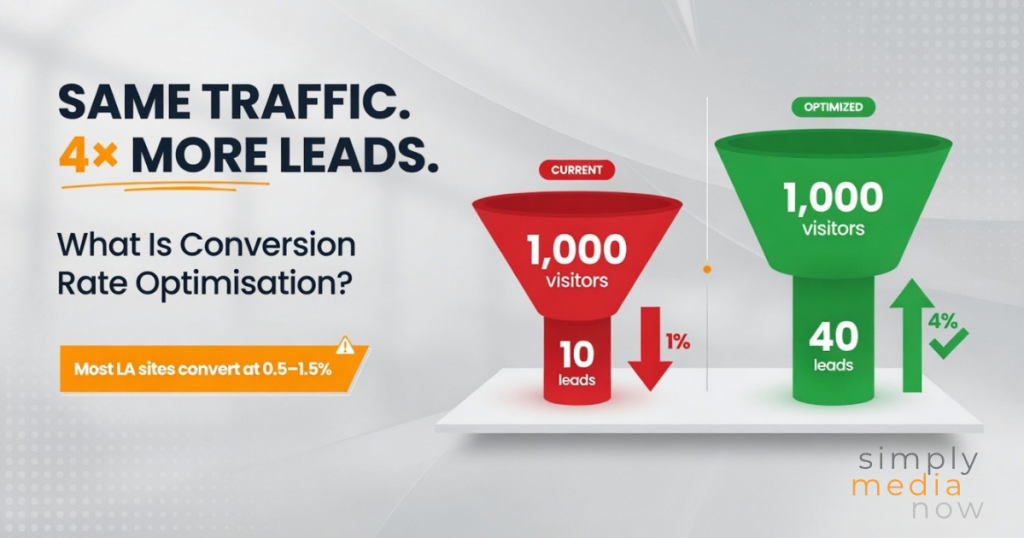
Most Los Angeles business owners focus their marketing energy on one thing: getting more traffic. More visitors, more clicks, more eyeballs.
But there’s a faster, cheaper, and often more effective approach that most businesses completely overlook: converting more of the traffic they already have.
That’s conversion rate optimisation (CRO) — and it might be the highest-ROI investment your LA business can make in 2026.
What Is Conversion Rate Optimisation?
Conversion rate optimisation (CRO) is the process of systematically improving your website so that a higher percentage of visitors take the action you want them to take — filling out a contact form, calling your business, booking an appointment, or making a purchase.
Your conversion rate is calculated simply: conversions ÷ total visitors × 100.
If 1,000 people visit your website this month and 20 fill out your contact form, your conversion rate is 2%. CRO aims to increase that number.
Here’s why this matters: doubling your conversion rate from 2% to 4% doubles your leads — without spending a single extra pound on traffic. If you’re currently spending $3,000/month on Google Ads or $1,250/month on local SEO, a higher conversion rate makes every pound of that spend work twice as hard.
What’s a Good Conversion Rate for an LA Business Website?
Benchmarks vary significantly by industry and traffic source:
- General service businesses: 2–5% conversion rate
- Professional services (legal, accounting, consulting): 3–7%
- E-commerce: 1–3% (purchase conversion)
- Landing pages with single CTA: 5–15%
- Local service businesses with strong reviews: 6–10%
Most LA small business websites we audit convert at 0.5–1.5% — well below industry benchmarks. This means the majority of visitors who could become customers are leaving without taking action. CRO addresses exactly why.
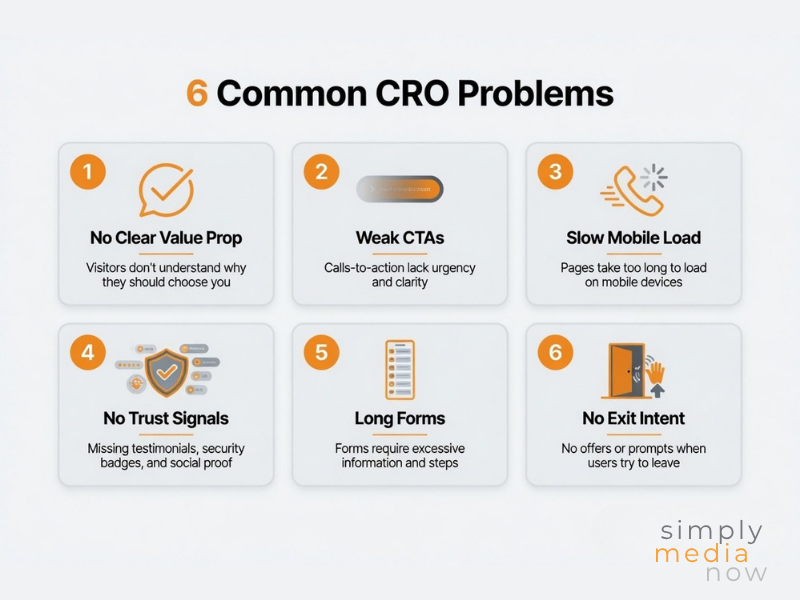
The 6 Most Common CRO Problems We Fix for LA Businesses
1. No Clear Value Proposition Above the Fold
Within 5 seconds of landing on your website, a visitor should know: what you do, who you serve, and why they should choose you over competitors. Most LA business websites fail this test. Visitors see a generic tagline, a stock photo, and a navigation menu — and leave.
The fix: Rewrite your homepage headline to be specific and benefit-led. ‘Los Angeles Digital Marketing Agency’ becomes ‘LA Businesses Rank Higher, Get Found Faster, and Generate More Leads With Simply Media Now.’
2. Weak or Missing CTAs
We regularly audit LA business websites where the only contact option is a ‘Contact Us’ link buried in the navigation. No visible phone number. No form above the fold. No compelling reason to reach out now.
The fix: Add a phone number in the header. Include a primary CTA button above the fold on every key page. Add an ‘offer’ CTA (free audit, free consultation, free quote) to incentivise immediate action.
3. Slow Load Speed on Mobile
As covered in our website design guide, 53% of mobile visitors leave after 3 seconds. In LA, where mobile traffic dominates, slow load times are a conversion killer. Every second of additional load time reduces conversions by approximately 7%.
The fix: Technical performance improvements — image compression, caching, server upgrades, code minification. Measurable, trackable, and immediately impactful.
4. No Social Proof or Trust Signals
An LA business website with no reviews, no testimonials, no results, and no local signals is asking visitors to take a leap of faith. In a market with abundant alternatives, most won’t.
The fix: Add a live Google reviews widget to your homepage. Include case studies with specific results. Add client logos. Display your physical address and a photo of your office. For service businesses, add before/after content.
5. Forms That Ask Too Much
Every additional form field reduces completion rate. A 6-field contact form converts at roughly half the rate of a 3-field form. We’ve seen LA business websites with 10+ field contact forms asking for budget ranges, timelines, and detailed project descriptions before initial contact.
The fix: Reduce to 3–4 fields maximum for initial contact. Name, phone, email, and one qualifying question. Collect additional information in the follow-up process.
6. No Exit Intent Strategy
The majority of website visitors will leave without converting on any given visit. Exit intent tools detect when a user is about to leave (mouse movement toward browser close) and display a targeted offer at that exact moment — ‘Before you go, book your free 30-minute consultation.’
The fix: Install an exit intent popup with a compelling offer. Done well, these convert 2–5% of would-be abandoned visitors.
CRO vs SEO vs Google Ads: How They Work Together
CRO is not an alternative to SEO or Google Ads — it makes both work better:
- SEO brings visitors → CRO converts them → result: more leads at no additional traffic cost
- Google Ads brings visitors → CRO converts them → result: lower cost per lead, better ad ROI
- Higher conversion rate → better Google Ads Quality Score → lower cost per click
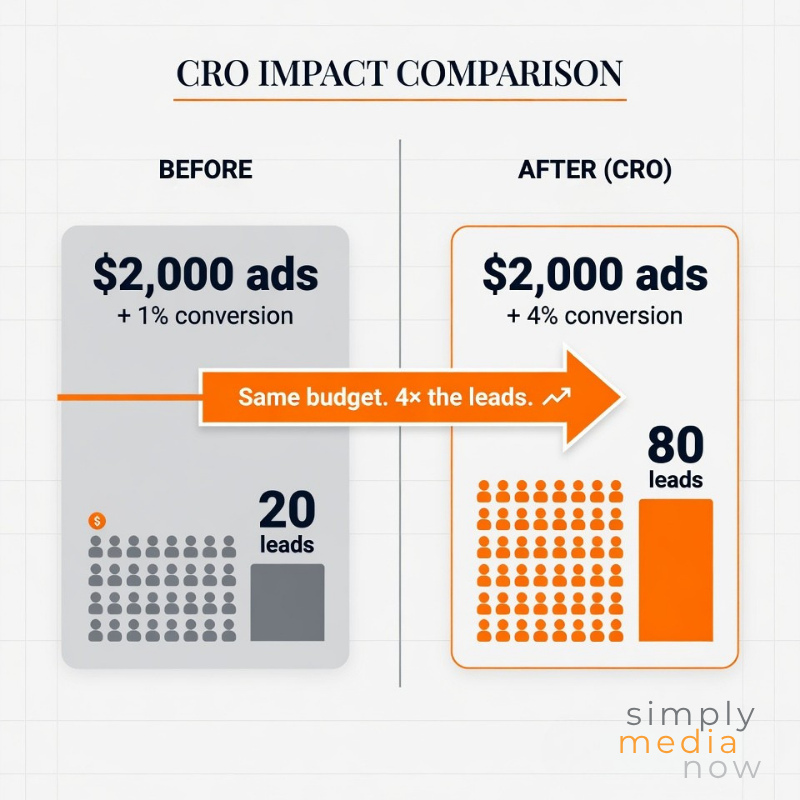
A business spending $2,000/month on Google Ads with a 1% conversion rate generates 20 leads/month. The same $2,000 spend with a 4% conversion rate (achieved through CRO) generates 80 leads. Same budget. Four times the output.
The CRO Process: How We Do It at Simply Media Now
Step 1: Audit and Baseline Measurement
Before changing anything, we establish your current conversion rate using Google Analytics 4 data. We identify which pages receive the most traffic, where users drop off, and which device types have the lowest conversion rates.
Step 2: Identify Friction Points
Using heatmaps (Hotjar or Microsoft Clarity), we see exactly where users click, scroll, and abandon. Session recordings show real visitor behaviour — what’s confusing them, what they’re looking for that they can’t find, where they’re giving up.
Step 3: Hypothesis and Test
We form specific hypotheses: ‘Changing the CTA button copy from Contact Us to Get Free Audit will increase clicks by 15%.’ We then test these hypotheses using A/B testing — showing version A to 50% of visitors and version B to the other 50%, measuring which performs better.
Step 4: Implement and Measure
Winning variants are implemented as permanent changes. We track the impact on conversion rate and lead volume over a 30–60 day period to confirm the improvement is sustained.
Step 5: Repeat
CRO is an ongoing process. After each test cycle, we identify the next highest-impact improvement opportunity. Conversion rates compound with each iteration.
Frequently Asked Questions
How much does CRO typically improve conversion rates?
Results vary widely, but well-executed CRO programmes typically improve conversion rates by 30–150% within the first 6 months. The businesses with the lowest starting conversion rates (below 1%) see the most dramatic gains.
Does CRO require rebuilding my entire website?
No. CRO often involves targeted changes to specific elements: headlines, CTA buttons, form design, page speed, and trust signals. Many high-impact improvements can be made without a full redesign.
How do I know if my LA business website needs CRO?
If your website gets more than 500 visitors per month but generates fewer than 10 contact form submissions or calls, CRO is likely the highest-ROI investment you can make right now.
Can CRO work alongside an existing SEO campaign?
Absolutely — they’re complementary. Higher conversion rates mean your SEO-generated traffic is more valuable. We run CRO work alongside our local SEO packages for clients who want to maximise both traffic and lead generation.